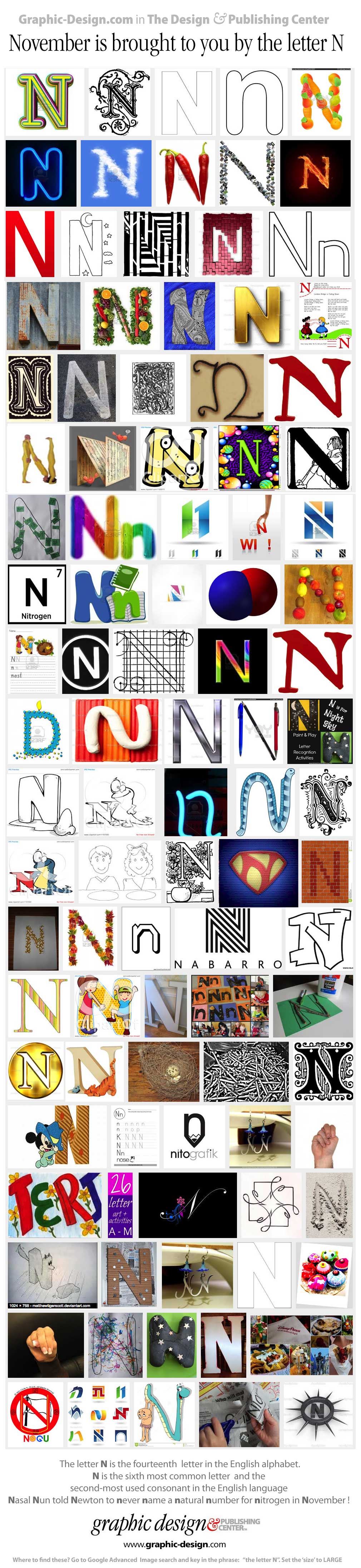
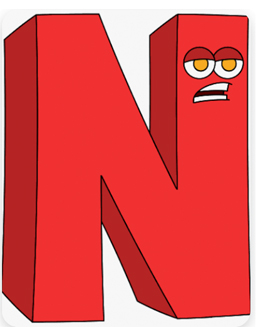
November is brought to you by the letter N
What has become . . . .
 n the early days of the web the computer still hadn't really made inroads into the graphic arts industry. The Design Center at DT&G was one of the very first sites that began publishing tips and tricks for graphic designers. Lettering and typography was a big part of the effort. Our monthly letter scheme started in 2006 and searching for "the letter N" was virtually nonexistent. Today, just try searching for the letter N. Ask yourself how many sites there are copying the monthly letter gig. I got it from Sesame Street. I had two toddlers who loved Ernie and the Cookie Monster who taught them all about just bout everything. But now, nine out of ten sites offering any kind of "lettering" are out for a buck. Now, they're behind robot captchas and paywalls. Now they pop up ads and cookies to cover their own content. It's bad.
Here's the original ... no ads, no stalkers, no cookies, no predators, and it's FREE for you to read and enjoy . . . .
 The early form of the N was always closely associated with water. When the sign was used by the Phoenicians more than three thousand years ago, it was called "num" (pronounced noon), which meant fish. Before the Phoenicians, the Egyptian Hieroglyph (or picture sign) for the 'n' sound was a wavy line representing water.
Around the 10th century B.C., the Greeks began adopting parts of the Phoenician alphabet as their own. In this way, they not only acquired the shape of the Phoenician nun, they also preserved its name -- to a point. Although the Phoenician character's name was meaningless to the Greeks, its initial sound became the sound that the sign represented. The Phoenician nun thus became the Greek "nu."
The squiggly nu doubtlessly upset those organized, rational Greek minds. thus obliging them to redesign the character slightly to suit their sensibilities. First they tried to give the angled strokes stability by making the last one a strong vertical support. But this made the letter (gasp!) asymmetrical! Obviously, this would not do, so the Greeks extended the other vertical stroke and made the two parallel.

The Greek N passed on to the Romans with virtually no change in the basic design. Over time however, subtle changes were made to all the letters the Romans borrowed from the Greeks and the N was no exception.
At first, the Romans, like the Greeks, incised their letters directly in stone. Or inscribed them in soft clay. These early letters had no variation in stroke thickness and lacked most of the curved strokes we have come to associate with the Roman alphabet. In the first century A.D., however, stonecutters began to paint the letters on stone prior to cutting them with hammer and chisel. It was this pre-drawing process that gave our current alphabet its variance in stroke weight, rich flowing curves and, ultimately serifs. During this evolutionary change, the N's outside strokes became thinner and serifs were added.
Thank you Allan Haley for this historic minute in typography history.
Allan Haley is a long time hero of the Design Center, and his expertise in typography and typographic design is second to none. His clients include Apple, Adobe, Linotype, and Monotype among others. Allan was executive vice president of ITC, and before that was in charge of typographic development at Agfa Monotype. He is highly regarded as an educator, and he is a frequently requested speaker. I met him through the Dynamic Graphics (DGEF) conferences series.
- Take a stroll through the trails of Allan Haley
- Ten thousand Ens from Google (you got to keep on scrolling!)
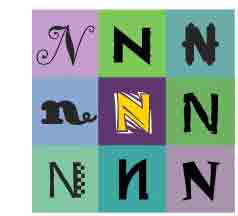
- 9 ways to draw a N (maybe to draw *an* N)
- Here's MORE How to draw the Letter N!
Please enjoy our “Letter N” poster for November suitable for printing and framing!
Thanks for reading

Don't forget ... we encourage you to share your discoveries about favorite or famous graphic designers and illustrators with other readers. Please post your suggestions and comments at DT&G on Facebook for discussion, or give me a tweet at @DTG_Magazine
➤ DT&G ➤Facebook ➤ X ➤ Medium ➤ Quora
© 1993 60-Seconds.com © DT&G 1988–2026 · All rights reserved. DT&G Magazine, and is a spam-free, ad-free, tracker-free, script-free, predator-free, stalker-free web site. 60-Seconds is a member of, and supporter of SafeNetting SpamCop.net, SpamHaus.org and UGNN InfoManager. DT&G (Design, Typography & Graphics) is a reader-supported, independent online publication established in 1988. It has been published continuously through successive online platforms—including commercial online services, email distribution, and, since 1995, the World Wide Web. There are no terms of service, no cookies and we won't spam you. DT&G is not interested in your identity other than what you wish to share with us in terms of talent, creativity and discoveries. The content here is protected by copyright and many trademarks are the property of their perspective owners. But none of our web sites require anything from you whatsoever other than a smile, a like and a share if you're so inclined.
FAIR USE NOTICE: This web site may make use of copyrighted material. Such material are made available for commentary and educational purposes only. This constitutes a "Fair Use" of any such copyrighted material as provided for in TITLE 17 U.S.C. SECTION 106A-117 of the United States Copyright Law.
Naughty ninjas noisily nibble nachos near noon!